
Three perspectives on multiple sclerosis, research and the Epstein–Barr virus
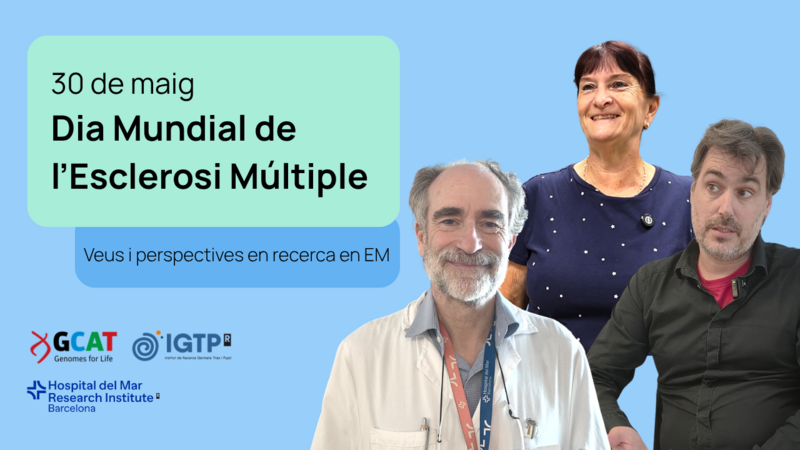
Watch the video here.
Multiple sclerosis is a chronic inflammatory and autoimmune disease that affects the central nervous system and is often diagnosed in young adults. Although significant advances have been made in recent decades in diagnosis and treatment, there is still no cure and it continues to represent a major clinical and scientific challenge.
On the occasion of World Multiple Sclerosis Day (30 May), the GCAT|Genomes for Life team, a strategic project of the Germans Trias i Pujol Research Institute (IGTP), has promoted a video explaining what research is being conducted to improve the lives of people with this disease. The video features the perspectives of neurologist Pablo Villoslada and researcher Gabriel Santpere, from the Hospital del Mar and Hospital del Mar Research Institute, with whom the team collaborates in the European project EBV-MS, as well as the testimony of a participant in the GCAT cohort with close relatives affected by multiple sclerosis.
One of the video's main focuses is the relationship between multiple sclerosis and the Epstein-Barr virus (EBV), a very common virus responsible for infectious mononucleosis. Although a possible link with the disease had been suspected for years, it was not until 2022 that a study led by the Harvard T.H. Chan School of Public Health and published in the journal Science demonstrated that it was a necessary cause for the development of multiple sclerosis.
In this context, the EBV-MS project is working to understand the biological mechanisms that explain this relationship and why only some people develop the disease after infection. The consortium, made up of more than a dozen European institutions and led by the University of Bergen, studies both viral genetic variants and genetic susceptibility, with the aim of developing new prevention strategies and future treatments.
The population cohort GCAT plays a key role in this research. Data and biological samples from thousands of healthy participants make it possible to compare genetic and environmental factors with cohorts of patients with multiple sclerosis and to deepen our understanding of the disease. The video also highlights the importance of public participation in biomedical research studies and the potential of population cohorts to advance towards more preventive and personalised medicine.